
#200 - Puzzle
1 Family Photo, 1 Dad-Joke, Many Highlights
Family Photo:
Easter Puzzle

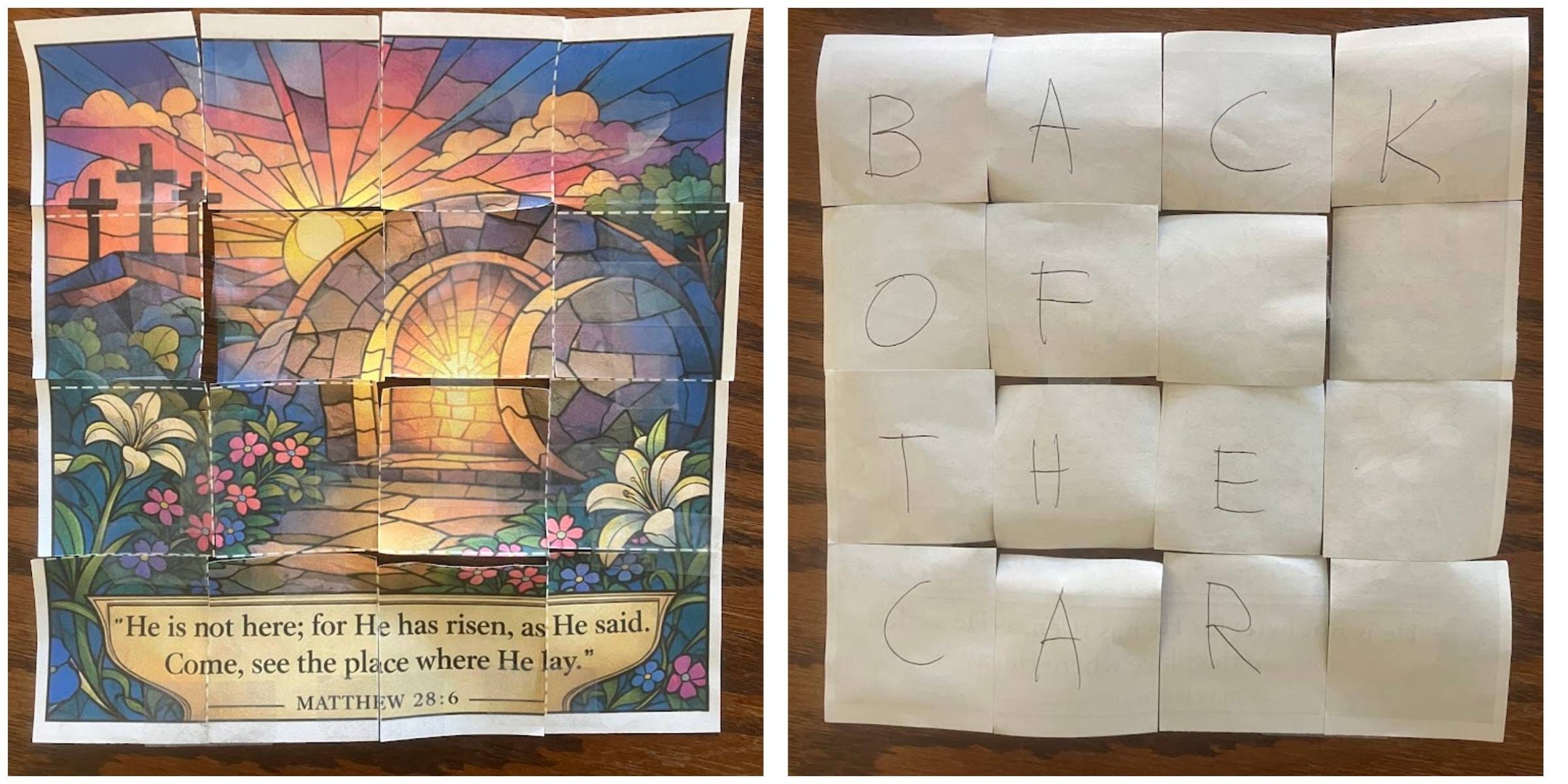
For Easter, Luana wanted to give each kid a big Easter present instead of the usual collection of chocolate eggs, fun-size candy bars, and Chuck E. Cheese prize-counter-schlock stuffed into plastic eggs.
We came up with the idea of a puzzle: I coaxed ChatGPT into creating an Easter puzzle picture, we sliced it into a grid, fit the pieces into Easter eggs, and hid the eggs around the yard.
We wrote a message on the back of the puzzle. After Calvin and Lawrence found the eggs, opened them, and assembled the puzzle, they flipped it over for a clue to find their LEGO sets.
--
I want Calvin and Lawrence to see the world as full of puzzles to be solved.
Why are things like that? How can we make stuff better?
How does a child acquire this perspective? I guess they need to be presented with puzzles—easy ones at first—and guided to solutions. Through repetition, maybe they’ll begin to see puzzles on their own. With practice, maybe they’ll both observe and figure out puzzles on their own. Even puzzles nobody else has solved before.
Dad Joke:
Qualification Puzzle
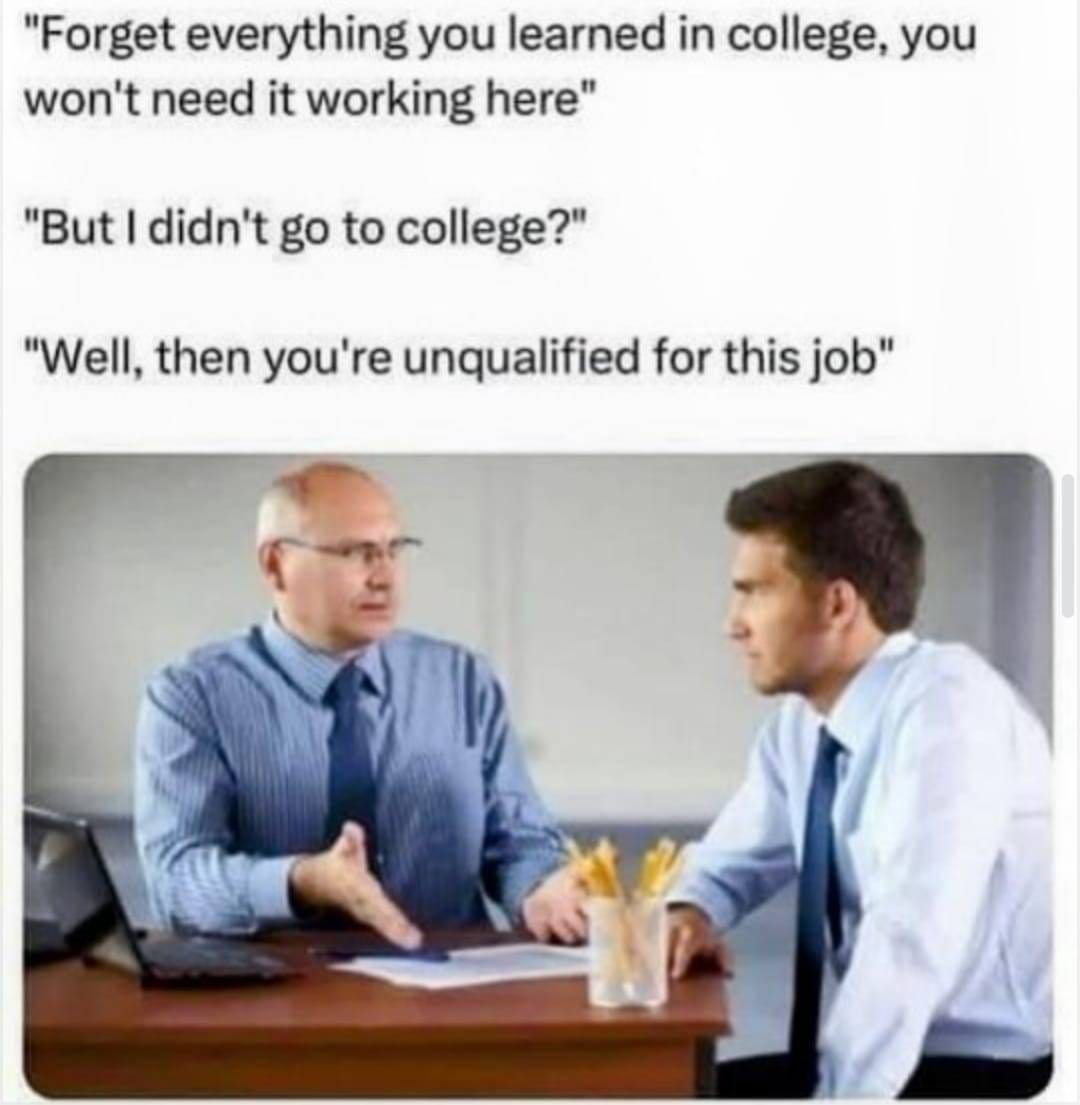
Source: Reddit
Highlights:
Education Puzzles
The Case Against Education by Bryan Caplan
If education boosts income by improving students’ skills, we shouldn’t be puzzled merely by the impractical subjects students have to study. We should be equally puzzled by the eminently practical subjects they don’t have to study. Why don’t educators familiarize students with compensation and job satisfaction in common occupations? Strategies for breaking into various industries? Sectors with rapidly changing employment? Why don’t schools make students spend a full year learning how to write a resume or affect a can-do attitude? Dire sins of omission.
--
I strive to teach my students how to “think like economists,” to connect lectures to the real world and daily life. When teaching educational signaling in labor economics, I tell students: Do you think you’re going to get a job that uses your knowledge of educational signaling? Probably not. Yet if you don’t learn the material, employers hold it against you. That’s the puzzle.
--
The Ivory Tower routinely ignores the real world. Strangely, though, the disinterest is not mutual. Employers care deeply about professors’ opinions. Not, of course, our opinions about epistemology or immigration. But employers throughout the economy defer to teachers’ opinions when they decide whom to interview, whom to hire, and how much to pay them. Students with straight As from top schools write their own tickets. A single F in a required course prevents graduation—closing the door to most well-paid jobs.
--
How then do economists fill eight semesters of coursework? With watered-down versions of topics that fascinate the faculty: supply-and-demand problems, mathematical economics, economic growth, and a long list of fields that are far less “applied” than they sound—macroeconomics, industrial organization, labor economics, regulation, public choice, economic history. From the standpoint of job skills, an economics degree is almost entirely chaff (except for budding economics professors). Yet despite our failure to prepare econ majors for their careers, the job market treats our graduates like engineers.
We Are Teaching Humans by Josh Brake
Education is not at its core about helping you memorize a bunch of information or build expertise. It’s about giving you the tools to understand why that knowledge is valuable and to what end those skills should be applied. It’s not that the information and skills are worthless; it’s just that they’re only a small piece of the puzzle.
Chase Your Reading by Robin Hanson
It seems to me that while reading non-fiction, most folks are in searching mode. Most would be more intellectually productive, however, in chasing mode. It helps to have in mind a question, puzzle, or problem, and then read in order to answer your question, explain your puzzle, or solve your problem.
In searching mode, readers tend to be less critical. If a source came recommended, they tend to keep reading along even if they aren’t quite sure what the point is. Since authors tend to be more prestigious than readers, readers tend to feel reluctant to question or judge what they’ve read. They are more likely to talk about whether they enjoyed the read, than whether the author’s argument works.
In chasing mode, readers are naturally more critical. When you are looking for something particular, it feels less presumptuous to stop reading when your source comes to seem irrelevant. After all, the source might be good for some other purpose, even if not for your purpose.
Active vs. Passive Learning by Morgan Housel
What gets most people’s minds moving is stumbling across a niche topic that either fits their unique mind or is a missing puzzle piece for a specific problem they’re having in life. It’s hard to foster that with active learning. You need to let people’s minds wander aimlessly, waiting until they discover what’s right for them at the time they need it.
Richard Feynman and The Connection Machine by W. Daniel Hillis
For Richard, figuring out these problems was a kind of a game. He always started by asking very basic questions like, “What is the simplest example?” or “How can you tell if the answer is right?” He asked questions until he reduced the problem to some essential puzzle that he thought he would be able to solve. Then he would set to work, scribbling on a pad of paper and staring at the results. While he was in the middle of this kind of puzzle solving he was impossible to interrupt. “Don’t bug me. I’m busy,” he would say without even looking up. Eventually he would either decide the problem was too hard (in which case he lost interest), or he would find a solution (in which case he spent the next day or two explaining it to anyone who listened). In this way he worked on problems in database searches, geophysical modeling, protein folding, analyzing images, and reading insurance forms.
The Mythology of Genius by Rohit Krishnan
[O]ur cultural vision of what a genius is seems filled with notions of someone who solves impossible puzzles impossibly fast. Is this what we want to encourage?
We’re All Innocently Out of Touch by Morgan Housel
Start with the assumption that everyone is innocently out of touch and you’ll be more likely to explore what’s going on through multiple points of view, instead of cramming what’s going on into the framework of your own experiences. It’s hard to do. It it’s uncomfortable when you do. But it’s the only way to get closer to figuring out why people behave like they do. Which is the puzzle we’re all trying to solve.
iamJoshKnox Highlights:
Easter Eggs
The newsletter has gone on long enough that revisiting early editions is like looking at different kids...and different adults. Many thanks to all who have participated and encouraged us along the way:)
Want to Be Interviewed?
I want to improve my interviewing skills:
Please REPLY if you’d like to do a 30-minute interview with me for a Podcast that doesn’t yet exist.
Or book some time on my calendar if there’s anything else you’d like to chat about:
https://calendly.com/iamjoshknox
Until next week,
iamJoshKnox