
Operation Carbon Speed
A Coordination Experiment for Direct Air Capture
This essay is a submission to the Astera Institute 2026 Essay Competition:
Identifying Systemic Bottlenecks to Science
By Peter Agbo and Josh Knox
Introduction:
The answer would seem obvious. Water-splitting is conceptually simple…anyone can demonstrate it on a kitchen counter with a battery and some saltwater. Moon landing, however, would require liquid-fueled rockets capable of escape velocity, guidance computers small enough to fit inside a capsule, life support for the crew, heat shields that wouldn’t vaporize on re-entry, and a manufacturing base to build it all to unprecedented tolerances.
Nine years later, we went to the moon. Sixty-five years later, we’re still trying to perfect clean hydrogen production.
Why? The bottleneck wasn’t scientific difficulty, it was the structure of the effort.
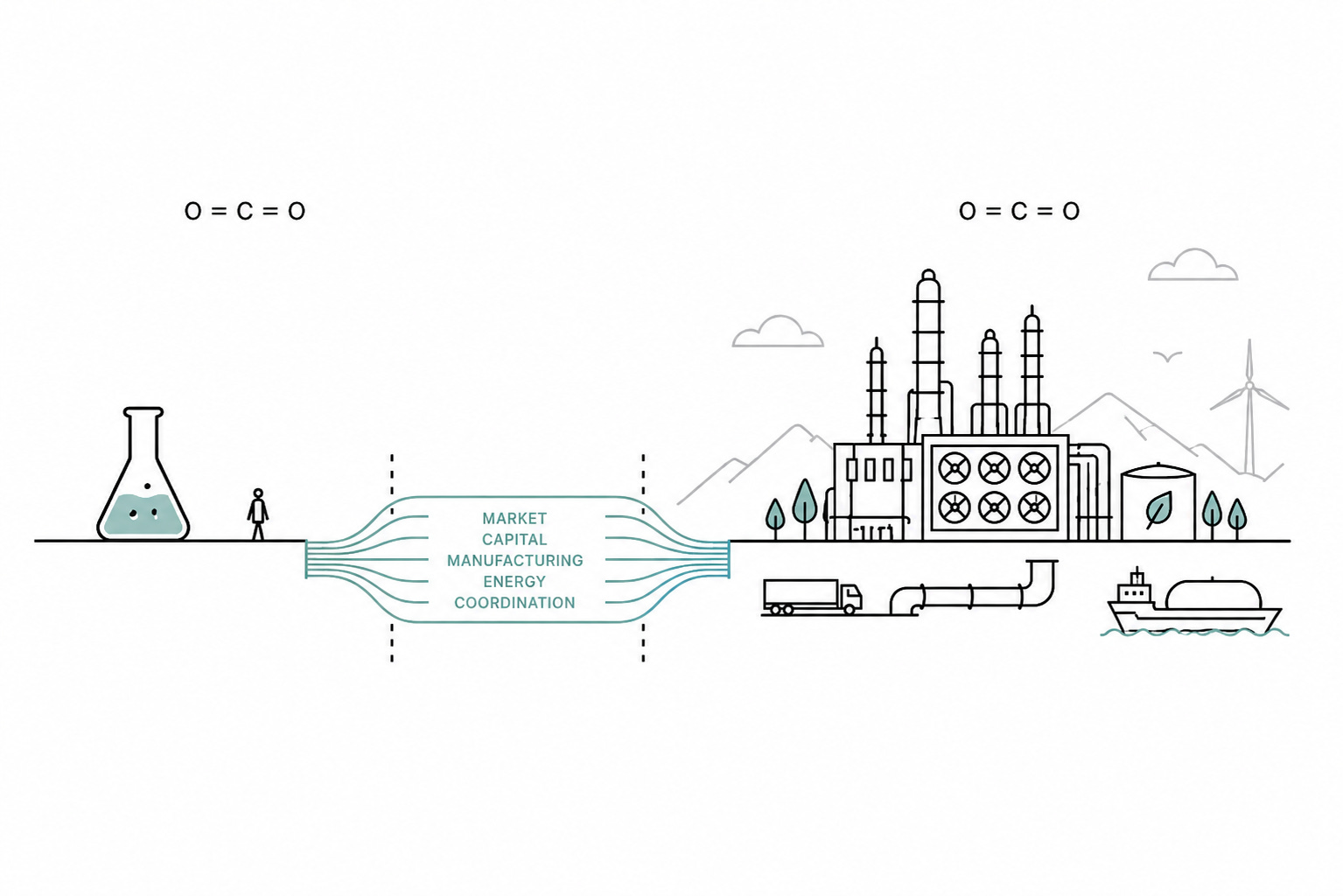
This pattern is not unique to hydrogen. Across science, the gap between “chemistry that works in a beaker” and “technology that scales to serve humanity” is rarely closed by more talent, more labs, or even more fundamental knowledge. It is closed (when it is closed) by a coordination framework: a market-maker guarantees a buyer for the output, a funding structure hedges across competing technical approaches, and an institutional mechanism develops manufacturing in parallel with the science rather than after it. When that framework is absent, proven science can sit dormant on a shelf for decades. When it is present, science can move from bench, to mega-scale, to the moon in under ten years.
This essay addresses the bottleneck where that framework is missing for an entire class of urgent, time-constrained scientific problems. Today’s research institutions are built for normal science – incremental advance of known approaches, on three-to-five-year grant cycles. They are structurally unable to coordinate the parallel scale-up that turns working laboratory results into deployed technology at scale. Without this framework, there’s a category of problems the research institution system cannot solve, no matter how much money or talent is poured in through existing channels.
We know such a framework is possible. We’ve built it before – more than once.
The Pattern: Science Stalls Without a Market
In 1905, Fritz Haber demonstrated nitrogen fixation from air into ammonia at laboratory scale. The chemistry worked. However, cheap Chilean saltpeter dominated fertilizer markets. No one was going to build high-pressure industrial reactors for a product they could dig out of the ground. Haber’s discovery would have sat on a shelf for decades, except…
In 1914, Britain’s World War I naval blockade cut off Germany’s saltpeter imports. Overnight, the German military became a guaranteed buyer at any price – they needed ammonia for explosives, and their survival depended on it. Carl Bosch invented the new field of high-pressure chemical engineering, and by 1918 German ammonia production reached 500,000 tons per year. The Haber-Bosch process underpins the synthetic fertilizers that now feed almost half of the world’s population.
The pattern: proven chemistry + no market + no urgency = stagnation. Add a market-maker and time pressure, the same chemistry moves from bench to mega-scale. Fast.
Operation Warp Speed replicated the pattern for vaccines in 2020, compressing a typical 10-to-15-year vaccine development cycle into under a year. Again, this was done not by accelerating the science but by restructuring the framework around it. The underlying mRNA technology was not new: Katalin Karikó had been publishing on it since the 1990s. The science knowledge was in the same state Haber’s chemistry once occupied – proven in principle, starved of the manufacturing investment that only a guaranteed buyer can justify. Operation Warp Speed changed that incentive structure: the U.S. government pre-committed to purchasing 300 million doses across a portfolio of vaccine candidates before any had completed clinical trials. Manufacturers built factories in parallel with development rather than sequentially. The market-maker did not accelerate the science – it accelerated the willingness to spend on everything around the science – and that, in both 1918 and 2020, accelerated the transformation of scientific knowledge into useful technology.
The category of problems for which this matters is broad: clean hydrogen, fusion, novel antibiotics, geothermal at scale. Each has the same shape – chemistry or physics that works in principle, but no market-maker to pull manufacturing forward, funding structures designed for incrementalism, and a clock running out.
Attack The Bottleneck: A Structure for Urgency in Direct Air Capture
As a concrete test case, let’s look at direct air capture (DAC), the suite of technologies for removing CO2 from the atmosphere.
Current global DAC capacity removes under 100,000 tons of CO2 per year. The IPCC’s 1.5°C pathways require 10 billion tons per year by 2100 – a gap of five orders of magnitude. But no law of thermodynamics forbids closing it – the bottleneck is not talent, infrastructure, or fundamental knowledge. DAC is stuck precisely in the “no market, no urgency” phase that the market-maker framework is designed to break.
One of us (Peter) has spent years building electrochemical CO2 capture systems – “dark electrolyzers” that convert dissolved CO2 into useful products at room temperature. The chemistry works. What does not work is the path from a bench demonstration to a megaton-scale facility: grant cycles run three-to-five years, while manufacturing scale-up to sizes that matter requires ten-to-fifteen-year commitments and a guaranteed buyer at the other end…Neither exists. So promising chemistries get optimized in glassware, published, and abandoned at the precise scale where they would begin to matter.
The math sets the stakes. Removing one million tons of CO2 per year, in the best case scenario, would require about 120 gigawatt-hours of electricity. Scale to 10 billion tons and that becomes ~1,200 terawatt-hours of clean energy devoted solely to carbon removal each year. The reality becomes more stark considering that incumbant DAC technologies operate far from the best case scenario, at about 2,000-3,000 kWh per ton CO2. At 10 gigaton scale removal, this would require 30,000 terawatt-hours of clean energy per year, more than all the clean energy produced on the planet in 2024. No single lab, company, or funding agency is structured to address this.
The bottleneck operates on three levels:
No market-maker. Captured CO2 has no buyer at the scale required to justify capital expenditure. Voluntary carbon markets are small, fragmented, and credibility-plagued. DAC startups today raise capital chasing voluntary corporate buyers paying $400-$1000/ton in tranches of thousands of tons – enough to keep a pilot alive, never enough to fund a gigaton trajectory. The absence of a buyer determines what gets built: small modular pilots optimized for press releases, not the large monolithic plants where economies of scale actually live.
Funding structured for incrementalism. Federal carbon-capture research runs through standard grant mechanisms: 3-5 year cycles, narrowly proscriptive funding opportunity announcements, and milestone-driven deliverables – the structure of normal science. The DAC problem instead requires parallel development across multiple platforms (electrochemical, sorbent, biological, mineralization), with the explicit acceptance that most will fail. DOE/ARPA-E proposals force researchers to commit, in advance, to specific approaches – the opposite of a portfolio program, where the portfolio is the de-risking strategy and individual failures are expected.
No mechanism for parallel scale-up. The standard model – prove the science, then build the factory – adds years or decades. For DAC, sequential is functionally equivalent to giving up on the IPCC timeline. Manufacturing novel sorbents, building specialized reactors, securing terawatt-scale clean energy supply chains: these must be solved in parallel with the science, not after it.
The Experiment: Operation Carbon Speed
Operation Warp Speed compressed vaccine development timeline from the typical 10-15 years to under one by restructuring the institutional framework: it signed guaranteed purchase agreements before clinical trials concluded, and created portfolio funding across three vaccine platforms and seven companies. The same structure that worked for Operation Warp Speed can be tested for Direct Air Capture.
The hypothesis: a coordinated program that (1) provides a guaranteed offtake price for captured CO2, (2) funds parallel development across multiple DAC technology platforms, and (3) integrates manufacturing scale-up with research from day one will compress the timeline to cost-competitive gigaton-scale carbon removal by decades compared to the current incremental approach.
Concretely, the experiment could look like this: a government or coalition commits to purchasing captured CO2 at a guaranteed floor price – start at $200/ton and decline on a published schedule toward $50/ton over fifteen years – creating the market that does not exist. Awards go to a portfolio of at least four technology platforms (electrochemical, solid sorbent, mineralization, hybrid biological), each with a sibling industrial partner contracted to begin manufacturing development simultaneously with the lab work, not after it. A dedicated coordination body, modeled on Warp Speed’s joint civilian-military structure, would manage clean-energy procurement, workforce training, and shared infrastructure (CO2 transport, storage, monitoring).
The experiment is testable because the metrics are concrete and the counterfactual is the current trajectory: cost per ton captured, tons removed per year, and time from laboratory demonstration to megaton-scale deployment.
A five-year checkpoint asks whether at least two platforms have crossed from pilot (1,000 tons/year) to demonstration scale (100,000 tons/year) at a cost trajectory beneath the offtake floor. If yes, the structural intervention worked and the program scales. If no, the failure is itself informative: it tells us the bottleneck is not what we thought, and rules out the most plausible structural diagnosis.
The portfolio matters. Picking a winner now – on the evidence available – would be a guess. Sorbent systems have manufacturing maturity but high energy demand. Electrochemical approaches have favorable thermodynamics in dilute streams but unproven scale-up. Mineralization is geographically constrained. Hybrid biological methods are early but cheap. The Warp Speed lesson is that the portfolio is the de-risking strategy; the experiment is invalid if a single platform is selected upfront.
If it succeeds, the framework can be applied to other problems in this category – clean hydrogen, fusion, novel antibiotics.
Why Now?
Three developments make this proposal timely rather than speculative.
First, compliance carbon markets are maturing. The EU ETS, California’s cap-and-trade program, and emerging national frameworks are assembling, in real time, the regulatory infrastructure a guaranteed-purchase mechanism requires.
Second, multiple DAC platforms have crossed laboratory proof-of-concept. Electrochemical approaches, solid sorbents, and hybrid biological-chemical methods have all demonstrated feasibility. We are no longer waiting for a single scientific breakthrough; we are waiting for the framework to pursue several in parallel.
Third, and most critically: we are running out of time to run out of time. The IPCC’s negative emissions requirements are not aspirational targets – they are load-bearing assumptions in climate models. Every year of delay grows the atmospheric burden and makes the eventual removal task larger. When a problem is both resource- and time-constrained, the rational response is to overinvest in resources to buy back time.
That is what Operation Warp Speed did. That is what DAC requires.
As Alex Azar, who oversaw Warp Speed, reflected during the pandemic: “We’d already spent $3 trillion. So there is no amount of money that we shouldn’t spend to get a vaccine faster. In business terms, there’s an infinite return on investment.” The same logic applies to carbon removal – except the stakes are not a single pandemic, but the long-term habitability of the planet.
Haber-Bosch turned atmospheric nitrogen into food for billions. Operation Warp Speed delivered vaccines faster than any program in human history. Neither succeeded through scientific genius alone – both required a structural intervention that removed the institutional bottlenecks standing between existing capability and urgent need. DAC faces the same category of bottleneck: the chemistry is proven, the talent exists, and the need is beyond dispute. What is missing is the framework. We should build it – and structure the build itself as an experiment, so that whatever we learn can be generalized to other problems of this shape.